Dana’s Dog Dash: Two dogs, five Coke Zeros, and one very important couch
November 8, 2026
Key points
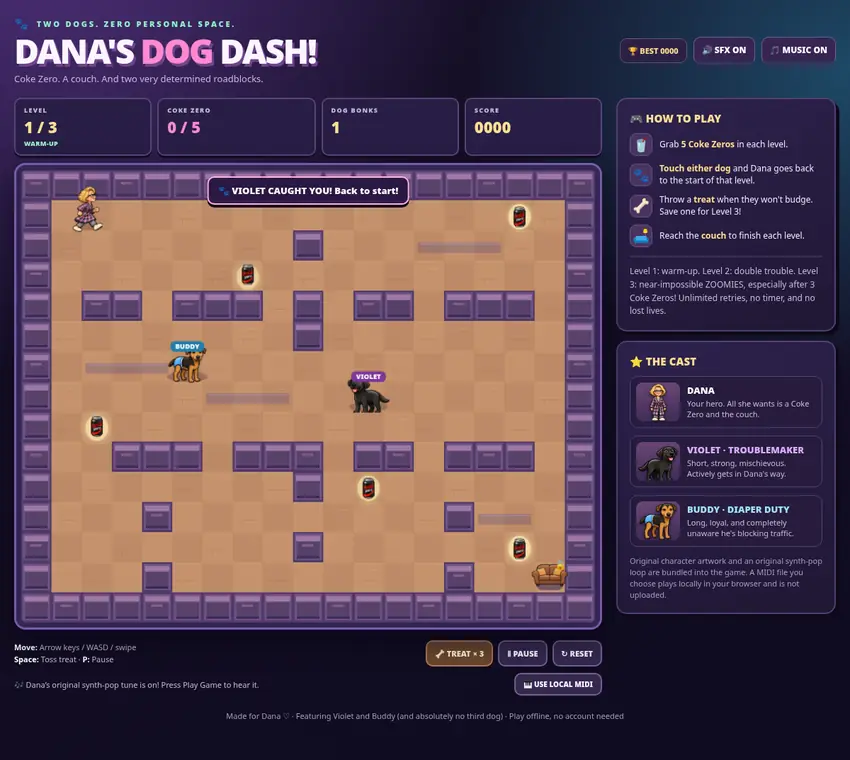
- Made Dana a three-level browser arcade game built around Violet, Buddy, five Coke Zeros per level and a couch.
- Used HTML5 Canvas, a tile grid and separate rendering, movement, collision and restart logic to keep gameplay consistent.
- Gave the dogs distinct rule-based behaviors, a treat distraction and a deliberately chaotic third-level Zoomies boost.
- Added an original Web Audio synth-pop loop plus local-only MIDI selection without distributing copyrighted music.
- Deployed the game on Vercel at danasdogdash.com; Dana played it, and loved it.
I didn’t set out to build the next big video game. I wanted to make Dana laugh.
In our house, two dogs have a gift for getting between Dana and wherever she’s trying to go. Violet is the shorter, stockier black dog with the confidence of a nightclub bouncer. Buddy is longer, leaner, and wears a blue diaper indoors. His job title is, naturally, Diaper Duty.
Somewhere in there was an arcade game.
That became Dana’s Dog Dash. Dana, in her plaid bathrobe and glasses, has to collect five Coke Zeros and reach the couch. Violet and Buddy have other plans.
Two dogs. Three levels. One couch.
I grew up getting lost in cartoons and video games. Making something like this lets me tap into that part of myself again, except now I get to put our household into the game.
The idea needed to stay simple: exactly two dogs, three levels, keyboard and touch controls, and a couch worth fighting for. No accounts, no ads, no leaderboard server to maintain. Just open it and play.
I built it with AI helping on the implementation. I drove the idea, reviewed the characters, adjusted the rules, and kept coming back with requests about how much trouble the dogs should cause. We iterated on the code, tested the behavior, and worked through deployment.
Some of those decisions were technical. Some were very specific household requirements. Dana has a short, wavy blonde bob, not a ponytail. Violet and Buddy are two different shapes. And an accidental nickname does not mean we’ve acquired a third dog.
Those details matter when you’re making a game for someone who actually knows the cast.
Making the chaos work
The game runs in the browser using HTML5 Canvas. Underneath the living room is a tile grid: walls, open floor, Coke Zero cans, dogs, Dana, and the couch all have positions on it.
That gives the game clear rules. Dana can’t walk through a wall. Moving onto a dog’s tile counts as getting caught, and so does a dog moving onto hers. Getting caught restarts the current level, including its collectibles and score, without wiping out completed levels. There are unlimited retries. The dogs are annoying enough without a game-over screen.
The code also keeps track of whether the game is at the title screen, playing, paused, caught, or between levels. Keeping those states separate makes it easier to handle things like stopping input during a reset or making sure the next level starts cleanly.
Canvas drawing uses requestAnimationFrame, while movement timing is handled separately. That lets us change how quickly the dogs move without tying their speed to how often a screen redraws.
It all lives in a self-contained HTML build with CSS, JavaScript, and embedded visual assets. There’s no database or backend required to play.
Violet and Buddy needed their own personalities
Two dogs wandering randomly around a maze would have worked, but it wouldn’t have felt much like our dogs.
Violet is the troublemaker. She favors chasing Dana, and that preference gets stronger as the levels progress. Buddy is less aggressive, but increasingly good at anticipating where Dana is going and getting in the way.
Their behavior comes from rules and settings on the grid. Each dog chooses among available moves based on its personality and what’s happening around it. There’s no language model running behind the scenes. A little arcade dog doesn’t need one.
Treats give Dana a way to distract them and create an opening. That matters because I wanted players to have something to try besides running faster and hoping for the best.
Then I asked for Level 3 to be nearly impossible.
And then came the Zoomies
Level 1 gives you room to figure things out. By Level 3, the dogs move faster, chase harder, and make those corridors feel a lot smaller.
Collecting the third Coke Zero triggers the Zoomies, which speeds them up again. The game announces it, so you at least know why your situation just got worse.
There are still routes through the maze and treats to help you escape. The challenge is finding the opening before Violet closes it. Make it through all three levels and Dana finally gets her couch victory.
We checked collisions, restarts, level progression, controls, and the win path as we worked through the builds. The goal was to make the difficulty come from the dogs, not from broken controls or a level that wouldn’t reset properly.
It needed an ’80s soundtrack
Sound effects were in early, but the background music took more work. I wanted that old arcade feeling without requiring a streaming service or a separate player.
The game uses an original synth-pop loop generated in the browser with the Web Audio API. JavaScript schedules the melody, bass, chords, and drums. Music starts after you press Play, which works with browser restrictions on autoplay, and music and sound effects have separate controls.
Dana loves Duran Duran, so we also explored MIDI. Changing a song into a MIDI file doesn’t make its composition free to distribute, though. The public game ships with the original loop instead.
There’s also a local MIDI option: choose a file and the browser reads and plays it without uploading it to a server. That gave us room to experiment without bundling someone else’s music into the game.
Giving Dana her own arcade
I wanted Dana to open a link on her phone and play, so I gave the game its own home at danasdogdash.com.
It’s hosted on Vercel as a static site. We worked through successive builds for collisions, music, and increasingly troublesome dogs, then connected the domain. I kept it separate from my personal website and other projects so changes to the game can stay with the game.
If I were starting again, I’d lock down the character names and appearances earlier. Fixing a ponytail is straightforward. Fixing it after it has worked its way into several assets is less fun.
I’d also keep checking the art and gameplay separately. The characters have to look right, but the controls, collisions, audio, and resets need their own attention. You notice very quickly when one of those is wrong, even in a game about getting to a couch.
What I like most is how personal this turned out. The bathrobe, the Coke Zero, Buddy’s diaper, Violet being a menace: none of it needed to be toned down to make the project worth building. That’s what made it worth building in the first place.
She tried it. It worked. She loved it. That’s the result I care about most.
If you’d like to meet Violet and Buddy, the game is live. Just don’t expect either dog to respect your personal space.